Brett's Comments at the August 02, 2023 KR3 Scoping Meeting

I’m Brett Duxbury. You all know me, but not everyone might. I’ve been a resident of Kernville for 16 years. I’m on the Board of Kern River Boaters and the Kern River Fly Fishing Council — both are California public benefit corporations with federal 501c3 status.

I won’t be making an argument for decommissioning like I did with KR3. I am not anti-all-hydro, just anti-pure-Run-of-River hydro, because the latter makes its power in spring, when demand is low and there’s a solar glut, and by late summer when our state needs all the energy it can get, its fuel — snowpack — has been spent.

Storage hydro on the other hand has positives for flood control, agriculture, time shifting energy to when its needed, and actually provides recreation rather than just taking it away all the time.

KR1 is a hybrid: it is Run-of-River, but it runs off storage — the Isabella reservoir — and so unlike KR3, KR1 helps with the steep net ramp and blackout potential in late summer. It also does not dewater a Wild & Scenic River.

The key with KR1 is to regulate it like you’re supposed to: in line with modern social values — not the values of Edison’s old-school hydro managers that tend to make their way through the agencies. If you make sure there remains plenty of water in the river for the public good, I will support this relicensing. Shocking, No?

GEOLOGICS:
I would like to comment on the project’s potential and continuing impacts on Highway 178 between here and Isabella, commonly called “The Canyon.”
The project conveys 1.5 million of pounds of water per minute hundreds of feet above 178.
In August 2013 the conveyance‚ including the emergency spillway, failed during a storm.
An Adit and the Forebay overflowed while Edison continued to pump water, adding fuel to the fire, so to speak. This caused two massive landslides across 178 and closed both lanes of the canyon for about two weeks.
The result of all this was that CalTrans sent Edison a bill for a half million dollars (and Edison wiggled out of it thanks to its political connections) and FERC increased the project’s hazard rating from “low” to “significant.”

I have two points to make about this.
First, a hazard rating of “significant” does not envision the potential for loss of a single life from a failure like this.
That is as out of touch with reality as FERC’s original judgement that the project posed a “low” hazard.
Cars drive fast on 178, and there’s lots of them. It is only by luck that those landslides didn’t kill anyone.
Edison admits it didn’t anticipate this failure, and there is no reason to think this or similar modes of failure can’t happen again.

Conveying millions of pounds of water above the unsuspecting public on a major highway is inherently dangerous to human life.
This project’s hazard rating should be increased to High in the public interest.

My second point concerns the continued closures of 178 from time to time. As we all know from this year’s long closure, that highway is key to linking the Kern River Valley with the outside world.
But it is all-too-frequently closed for shorter periods from smaller rockslides. Myself and others think most of those closures are near the sites of the two landslides Edison caused in 2013 — below Adit 17/18 and the Forebay.

We suspect the hillside stabilization Edison was ordered to undertake was not fully successful.
I ask that an independent engineer perform an analysis of CalTrans 178 closure and repair data.

If that shows a disproportionate number of closures below the Adit and Forebay, the engineer should re-evaluate the hillside for further stabilization measures, which you should then direct Edison to perform prior to issuing a new license.

AQUATICS: FISHERY
According to the rank and file of the Kern River Fly Fishers Club, there used to be bass in this section of river. Folks could pop up after work and enjoy a few hours of fishing.
That incredible resource is not gone. It seems the sediment management plan dreamed up by Edison’s consultants destroyed that fishery.
I understand the plan was approved by all the agencies, but just like FERC’s safety rating, agencies don’t always get things right, and sometimes make huge mistakes. We can’t afford another one here.
Make Edison haul their sediment away, provide radically increased minimum flows, and order Edison to reestablish a viable fishery.
And be skeptical of Edison objections purportedly based on the environment; Edison is adept at using those as a fig leaf to protect their take of water from the river, like they do with the Hatchery up at KR3.

RECREATION
It is 2023, right?
Flow information for every other river segment is available online — even at the Kern Canyon Project.
Why as a boater do I have to sit through a three-minute phone message that is barely intelligible to find the flow below Democrat dam? (Really, try it out when you have a chance: 760-537-6356.)
I have to do that because Edison never gives an inch more than its license demands. And it often finds a way to give less — look back into the portage and fish ladder issues at Fairview Dam.
We need instantaneous online flow information below Democrat dam to safely use the river. Please provide it.

LAND USE & AESTHETICS
The lower Kern has been incredible to look at this year.
That has not been the case the last three years or any time the project reduces the river to fish flow, which is usually a paltry 15 cfs while the project takes 400+.
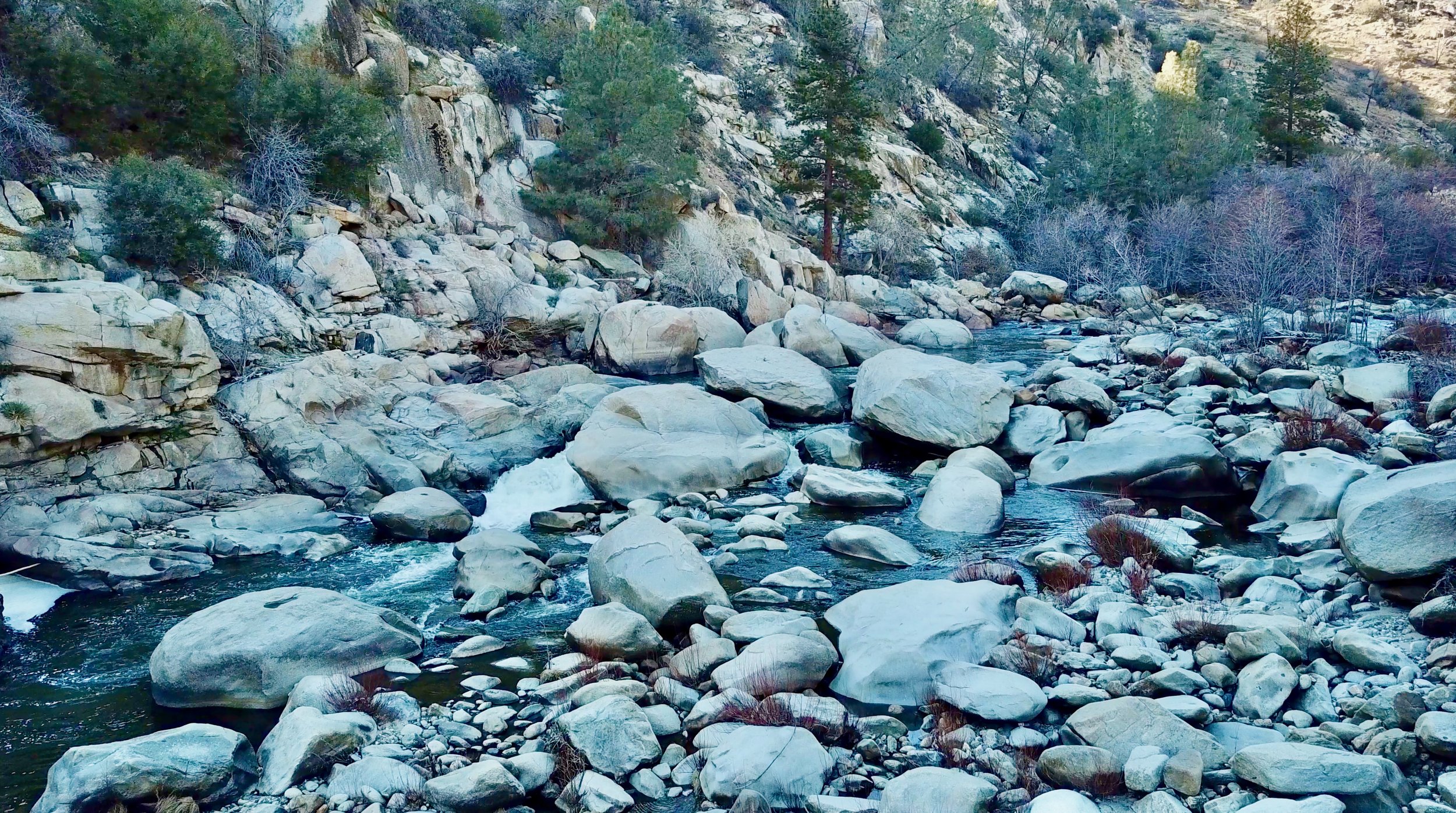
At those times you see stagnant pools, lots of algae, and where there is moving water, it is narrow, slotted, slow, and hard to see through the road blast.
There was Facebook video last year of a low flying helicopter over fish flow and you could barely make out any patches of water — it looked more like a rock quarry than a river.
According to CalTrans, 2-3 million people drive the canyon one-way each year. Those people — and the day users — deserve something better to look at than a dead river.
I ask that you carefully study aesthetics — not with easily manipulated survey data but with a science-based controlled flow study — and then radically raise minimum flows to keep this looking like a healthy river all year long.
That would also improve water quality, the fishery, and day use recreation, but I know those are separate resource issues — See how they divide and conquer project effects to isolate them and make them look small?

ENVIRONMENTAL JUSTICE
I thought you were supposed to analyze for economic justice as well as environmental? This comment applies to both.
You will probably find the day users of this river disproportionately come from communities suffering economically and environmentally.
There are limited opportunities for quality outdoor recreation around here at the price of this river — about $10 for a family — and the river offers improved air quality and an opportunity to get away from a desert littered with industry and surrounded by big Ag to a better setting (when there’s water), if only for an afternoon.
It follows that the project’s effects on river aesthetics, water quality, and the fishery disproportionately affect these communities.
You should strive for a radically more equitable balance on flows between the public and the powerplant — Heck: make a mistake on the public’s side for a change instead of Edison’s.

Wind+Solar Curtailment and the KR3 Hydroproject

Summary: Due to the increased and increasing use of solar and wind power, which typically has to be consumed by the end user as soon as it is generated, California's grid already creates too much power during some times of the day. This is particularly true in the winter, spring, and fall months, when demand for power to cool homes is lower. During these times, California's solar and wind power generating resources are deliberately turned off to prevent overloading the grid. Yet inexplicably, KR3 remains online generating unnecessary and unneeded power. This post explains why KR3 should be taken offline during the hours of 9am and 3pm from February to June. During these periods of vast excess power generation from other sources, the highest and best use of the Wild and Scenic North Fork Kern is not power generation — there is too much of that already — but natural flows for recreational use and environmental protection.

Updated with 2023 CAISO data, May 29, 2024.

The deployment of renewables in California has been incredibly successful to this point on our state’s path to a green grid. However, it has brought along an unanticipated consequence: the threat of over-generation — that is, generating more power than the grid can handle. All power must serve a load, and system operator CAISO works tirelessly to equalize supply with demand. Balance has become more difficult with the deployment of renewables like wind and solar, which increasingly threaten to swamp the grid with too much energy production during daylight hours, leaving supply well above the levels of demand. That’s the risk of over-generation.

CAISO’s main strategy to prevent over-generation and balance supply with demand is called “curtailment,” which does what it says: curtail (lessen) the amount of generation by modern solar and wind generators whenever the grid is threatened. We’ll let CAISO speak for itself on the matter:

“Curtailment is the reduction of output of a renewable resource below what it could have otherwise produced. . . . Curtailing renewables results in lost opportunities for clean resources to generate all of the carbon-free power that otherwise could be produced. . . . Curtailing renewables is counterintuitive to California’s environmental and economic goals. It reduces the output from the renewable plants in which the state has invested, and could result in overbuilding renewable plants to ensure that the state meets its 50-percent renewable mandate

So curtailment as a strategy, while effective in keeping the grid safe, is not a desirable public policy. One of CAISO’s strategies to reduce the need for curtailment is to “reduce minimum operating levels for existing generators, thus making room for more renewable production.” In other words, reduce production to make room for wind and solar, keeping those more modern and rational generators online and profitable, so more will be built. That’s where the KR3 hydroproject should come in.

KR3 is a contributing cause to curtailment. Whenever over-generation is threatened, KR3’s production of electricity only adds to that threat, and causes modern generators like wind and solar to be sidelined to ensure that supply and demand balance out. The times when over-generation are threatened are ripe for reducing the output of KR3, “thus making room for more renewable production,” in the words of CAISO.

When are these times? According to the data, significant curtailment massively prevails between 9am and 3pm. This chart depicts the average daily curtailment for each hour in 2023:

Note we have included for reference the average rate of generation at KR3: 13.5 kW. KR3 almost never achieves its top rate of 36.8 kW because the “fuel” needed to obtain that rate — 600 cfs of diverted river water — is unavailable far more often than not. Indeed, as the following chart shows, KR3 routinely generates at a fraction of its top rate. KR3 generates at its highest rates in spring, energy demands are low and renewable curtailments are high. In all but the wettest of years, KR3 is generating at extremely low levels during late summer and early fall, when demand is high and the potential for “loss of load” (blackouts) is acute:

Back to the issue of renewable curtailment, it is important to note the phenomenon’s seasonal component in addition to its hourly nature. In winter and especially in spring, demand is relatively low, forcing widespread curtailment of wind and solar assets. The following graph depicts average daily curtailments quarterly in 2023. Note how the figures in Q1 & Q2 dwarf the KR3 reference line during sunlight hours. Indeed, each horizontal axis line represents a ten-fold increase above the average power that KR3 has generated over its current license term:

Combining those two aspects of curtailment — hour of the day and time of year — is revelatory. The following chart depicts CAISO curtailments in 2023 between the hours of 9am and 3pm for the months with the greatest amounts of renewable curtailment — February through June — and adds a reference line of KR3’s average generation for those months:

Again, each horizontal axis line in the above chart represents ten times the average generation at KR3 during those months. The chart supports the proposition that the energy generated by KR3 is simply not needed during the hours of 9am and 3pm February through June. Renewable curtailments during those hours in those months occur at a scales dwarfing the power KR3 generates. If KR3 were to go offline during those hours, its energy would be replaced by a vast pool of renewable generators that would otherwise sit idle.

Let’s focus in on those months, and compare average curtailments in 2023, by hour, against the average rates of generation for KR3. Starting with February 2023, curtailments between 9am and 3pm are more than 20 times greater than KR3’s average (15.1 MW) for that month. Again, the horizontal scale lines represent ten-fold multiples of KR3’s monthly average rate of production for February, showing that between 40 and 90 times the production of KR3 is curtailed.

Even as KR3 increases its average generation rate to 15.8 MW in March, curtailments went higher still, sidelining wind and solar in amounts more than seventy to one hundred ninety times larger than KR3’s average rate of output that month:

Moving to April, we see average hourly curtailments at a scale of more than seventy to one hundred twenty times the average rate of KR3 generation:

For May, we see average hourly curtailments at a scale of more than forty to sixty times the average rate of KR3 generation:

For June, we see average hourly curtailments at a scale of more than thirty to forty times the average rate of KR3 generation:

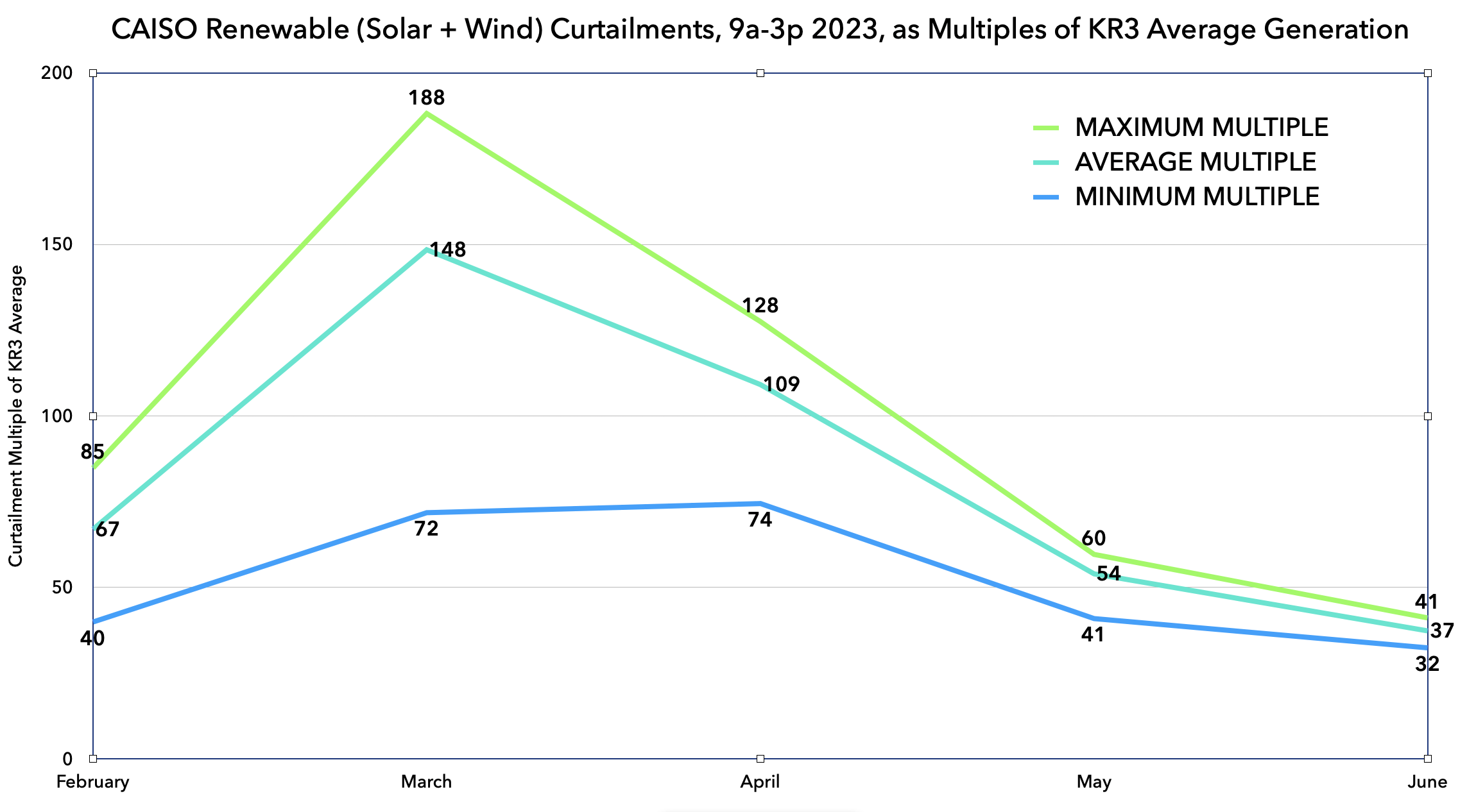
The following chart summarizes the preceding charts from February to June, showing the scope of renewable curtailments between 9am and 3pm as minimum, average, and maximum multiples of average KR3 generation:

We believe these figures show that the energy KR3 produces during the hours of 9am and 3pm is not useful to society from February to June. It makes no sense to dewater the Wild and Scenic North Fork Kern during those hours when renewable generators with at least 32 times the generating power of KR3 — and usually much, much more — are sitting by idle on the sidelines. And don’t forget: according to CAISO the scale of renewable curtailments is expected to increase over the years of the next KR3 license as more and more wind and solar come online. KR3, by contrast, cannot increase its output over its historical averages, as the project is capped at diverting 600 cfs and is limited by unimpaired river flows, which, although they will continue to vary year-to-year, cannot be expected to appreciably change in median volume over the next license term. Given these facts, the water currently diverted for KR3 at these times should, going forward, be left in the river to maximize the social good.